🌾🌾 EXHIBITION 🌾🌾
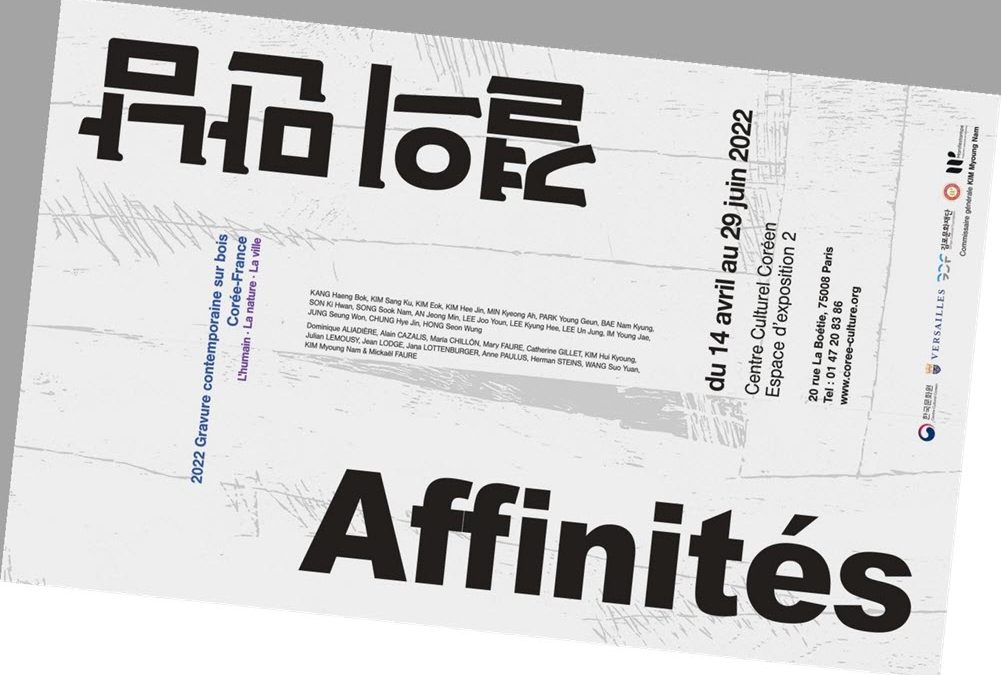
This will take place from April 14 to June 29, 2022.
Opening on Wednesday April 13 from 6 pm
Here is the press release from the Korean Cultural Center in Paris.
This exhibition takes place as part of a Franco-Korean artistic event, Affinités-Rencontres de Gyeol*, organized in the spring of 2022 on the initiative of the artist KIM Myoung Nam and taking place almost simultaneously in five places, both in Gimpo, South Korea, and in the Paris region in particular.
The curator has chosen the prism of wood engraving to highlight the plastic and sensitive links between the works of 17 contemporary artists working in South Korea, and 14 visual artists residing in France.
This series of exhibitions is part of the 10th Print Festival in France, an annual event that sheds particular light on this means of artistic expression that is firmly part of the landscape of 21st century art. . This is also the first large-scale exhibition devoted to wood engraving offered by our Centre.
“We hoisted the sails to take a trip between Korea and France through woodcuts; this trip is called Affinities-Gyeol Meeting. Despite the dark context in which our societies are currently immersed, artists never cease to question the very essence of human life and freedom. What is the value of human beings living in nature and cities? What are the perspectives of art? Is the enjoyment of art infinitely possible? Although the world is going through a difficult period, some thirty artists from Korea and France have had the courage and tenacity to organize this spring 2022, a great celebration of woodcuts in Gimpo, Paris and Versailles. . Through these exhibitions, like on a journey, they deploy a vast panorama of printed works,innovative and plural. »
General Commissioner, KIM Myoung Nam
.
In the era of all-digital technology that has invaded our daily lives, ancestral printing techniques continue to be favored by certain artists to create works of contemporary expression. In the field of woodblock printing in particular, Korea has historically occupied a remarkable place since the 8th century and several great masterpieces are today considered national treasures.
.
In the much more recent past, we can recall the exceptional growth experienced by wood engraving in the 1970s and 1980s through Minjung art, a movement that brought together many very committed artists. Their protesting, even revolutionary graphic works marked this era and many current artists are part of this heritage. Thus, the vast and abundant Jeju-requiem of HONG Seon Wung pays homage to murdered innocents.
.
Within these plural exhibitions, the viewer will perhaps get lost in the landscapes of KIM Eok, in the urban views of Gimpo engraved by LEE Un Jung, or even in the reflexive landscapes of BAE Nam Kyung, all of which question the place of man in our cities. The themes of man, the city and also nature are addressed in turn. The trees of KIM Sang Ku are a majestic illustration of this.
Although having a different chronology, the history of wood engraving in Europe and France is also very rich and very old both in the printing sector and in that of the production of works of art and, very naturally, many contemporary artists in France continue to choose this powerful means of expression, like Julian LEMOUSY who questions the notion of freedom in our cities, or even Jean LODGE who put the human figure at the heart of his woodcut works for several decades.
This woodcut exhibition brings together works of very diverse forms ranging from large-format prints to volume installations, including the presentation of several artist’s books; it opens up so many spaces for dialogue and encounter. Because it is above all about encounters, artistic and human encounters…
In addition, around this exhibition, the Center offers various programs such as woodcut workshops with Korean artists on May 30 and 31 (duration: 3 hours, 2 pm-5 pm) and a conference on May 5 at 6 pm These workshops are open to adults of all levels, and this program allows the public to discover printmaking in a fun way.
* Gyeol: term specific to Korean, without French translation, which refers to sensory terms such as grain,the waves, the texture of a material, the fibres, the waves… Gyeol is sometimes poetically translated as “the grain of the wind”.This expression evokes the soft and reciprocal fluidity of the interaction in thought between several subjects such assensual waves spreading harmoniously from person to person.