
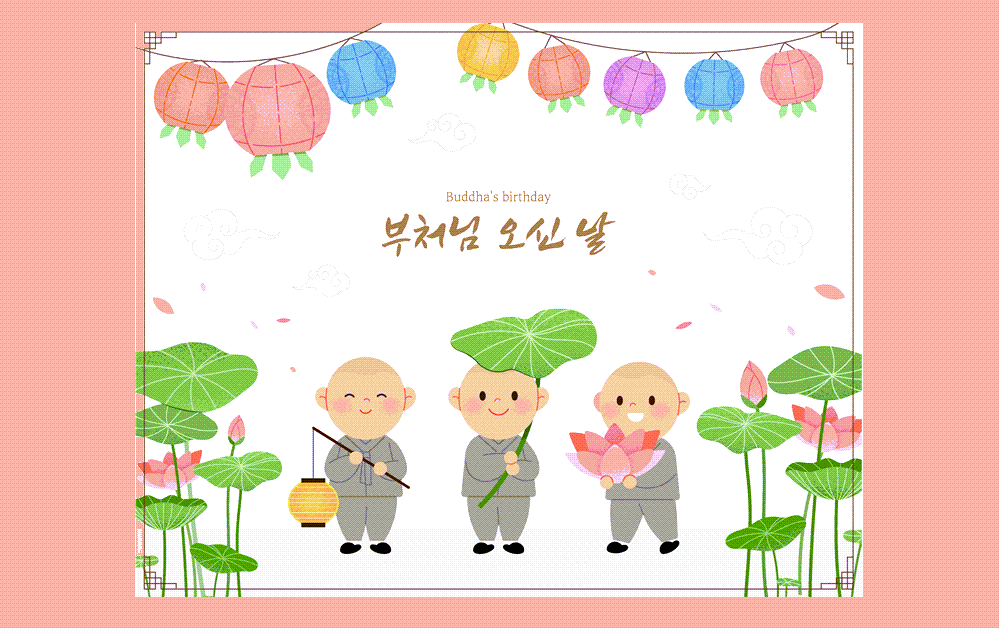
In Korea today is Yeondeunghoe 연, the ‘Lantern Festival’ an event that celebrates the Buddha’s birthday (Bucheonim osin nal 부 오 날).
As this date approaches, a multitude of traditional colored paper lanterns, bearing the wishes of those who made them, adorn the entire South Korean peninsula.
This festival is held for Koreans and according to the lunar calendar, on April 8 (the 8th day of the 4th lunar month) and is the subject of many extraordinary parades throughout the country.
Why do we celebrate this event today on May 8?
The world does not live at the same calendar rhythm, (nor at the same rhythm all, but we already knew that) we base ourselves on this side of the earth on a calendar called solar.
The Chinese lunar calendar is based on the lunar cycles or phases of the moon, that is to say that the first day of each month coincides with the new moon, and the 15th day coincides with the full moon.
The Chinese lunar calendar is about 20-50 days behind the solar calendar, so in “our” solar calendar, this year’s birthday falls on May 8.
This celebration was designated by Unesco as part of the national intangible cultural heritage in 2012 (in the same way as the traditional preparation of Kimchi if you did not know it)
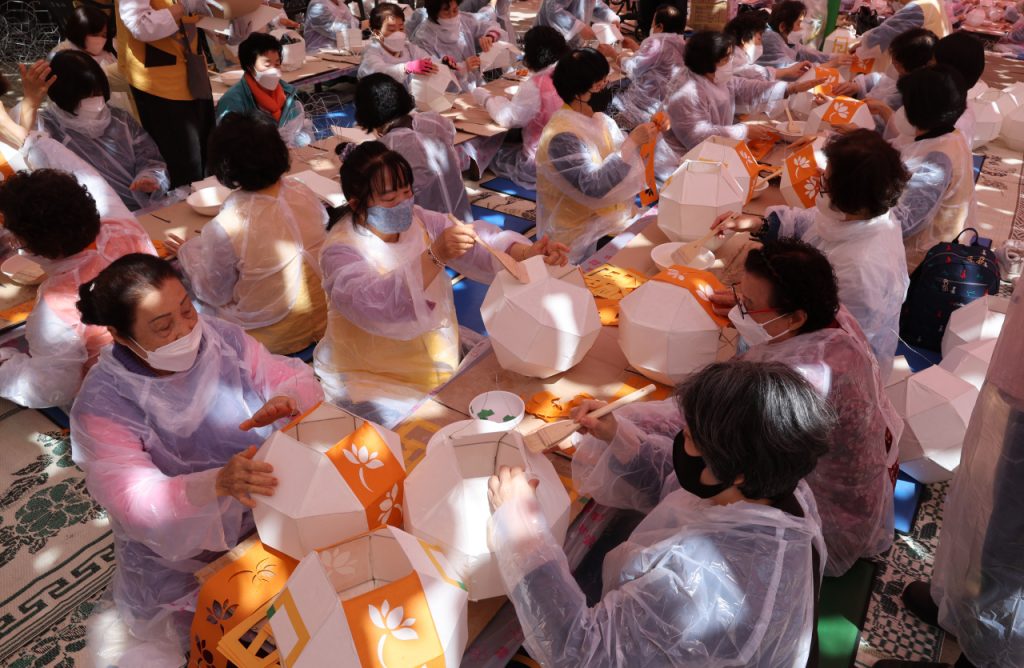
Traditionally shaped like lotus flowers, these thousands of lanterns are handcrafted each year by students, association members and many families.
This allows everyone to take part in a manual activity that not only strengthens social and family ties, but also teaches patience and group work.
The origin of this festival dates back more than 1,300 years, at the time of the kingdom of Silla (57 BC – 935 AD) it was initially a religious rite commemorating the birth of Buddha.With a powerful symbolism, the burning of all these lanterns represents the awakening of the latter, and the resulting explosion of light aims to chase away the darkness that oppresses humanity, spreading peace and wisdom on the world.
Although of Buddhist origin, these festivities nowadays attract many participants of all faiths every year, and are the occasion for large colorful gatherings and parades that bring together thousands of people holding lanterns in their hands.
Creativity is also required, since the latter take on ever more varied and impressive forms from year to year.
Sources CCCP et Yonhap
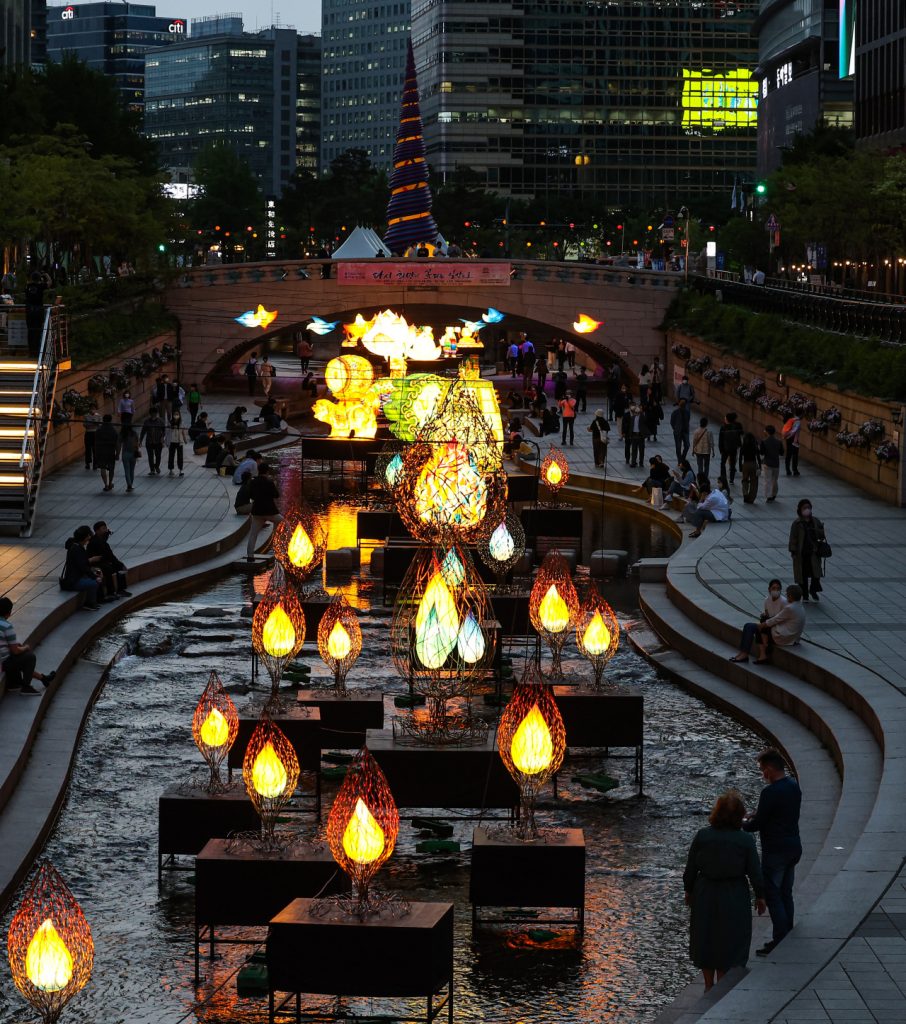
Cheonggye Stream, central Seoul (credit Yonhap)
.
Shall we take a short trip to Korea to see these beautiful lanterns up close?
(at 1:42 minutes from the video we hear someone in the audience speaking French, lucky ones!!)
VIDEO CREDIT: SEOUL TRAVEL WALKER